
Pink Tentacle has a great post about Japanese visions of the future from a 1969 illustrated magazine feature entitled “Computopia.”


My favorite:

More pictures and descriptions here.
Pink Tentacle has a great post about Japanese visions of the future from a 1969 illustrated magazine feature entitled “Computopia.”
My favorite:
More pictures and descriptions here.
Worth a thousand words…

Caption, anyone?
Covers of The New Yorker can sometimes be quite clever, but my favorite in recent history is Chris Ware’s Halloween cover. I was chuckling sarcastically as soon as I pulled this out of my mailbox.
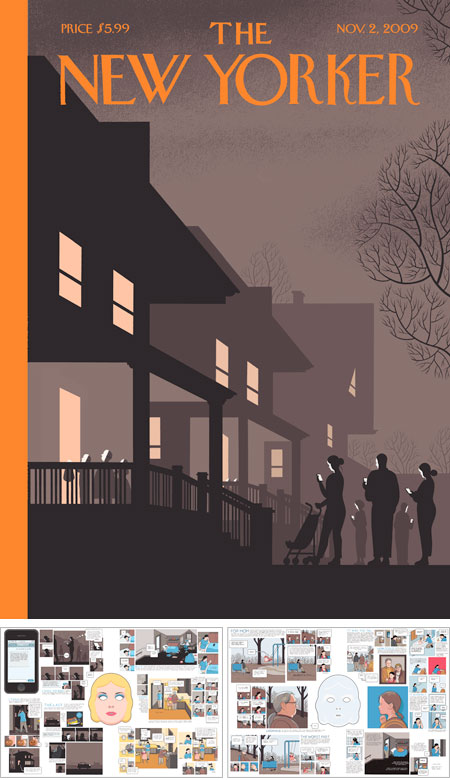
Poignant little commentary, no?
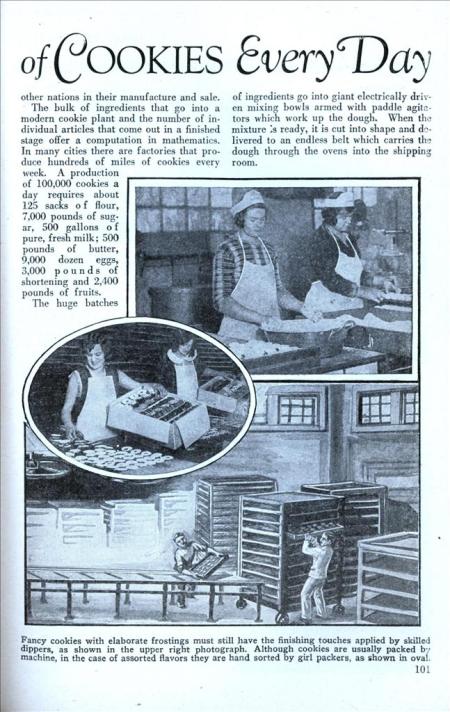
Okay, the article is not very interesting. But the headline made my day. Adds a little romance to the fact that we’re looking at a plain old industrial factory. Isn’t “a hundred miles of cookies” just a gorgeous utopian dream? It conjures up Candyland images of winding edible paths leading to houses made of gingerbread and icing.

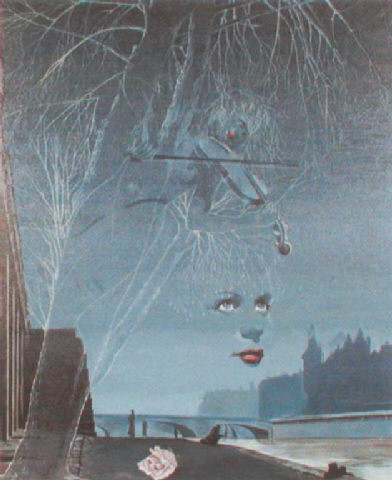
Not much information exists for the general public about Jean Marembert. He is featured in the book Modern Figurative Painting: The Paris Connection
From the book description:
The first half of the 19th Century spawned one of the most exciting concentrations of artists and artistic innovation in history. The French impressionists opened the door to creative freedoms never before experienced, and a community rich in artistic and intellectual talent coalesced to forever change the direction of art.
Here are a few of Marembert’s illustrations for Petrus Borel’s Le Lycanthrope, which I especially love:


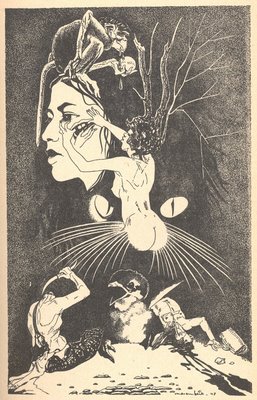
He seems slightly ahead of his time with these macabre collage illustrations.

Horror novels, comics, graphic novels and other forms of illustration in this style began to develop in the mid 20th century…though I don’t recall ever seeing anyone cite Marambert as an influence.


Tar magazine editor Evanly Schindler set out to “explore the intersection of art and fashion from a perspective that is both intellectually pointed and socially conscious but still stylishly produced.”
Damien Hirst designed the cover for April’s issue of Tar magazine; a somewhat de-fleshed Kate Moss, brandishing the sweet curvature of muscle tissue.

From the New York Times article:
It is not the idealized cover image you might expect would help to sell a magazine, though the distortion is really not that different from the extreme retouching that routinely goes on at mainstream publications to make celebrities look “better,” only to make them look like aliens.
I am very curious to browse this magazine and see how they achieve the intended expressive balance.
 SheWalksSoftly
