
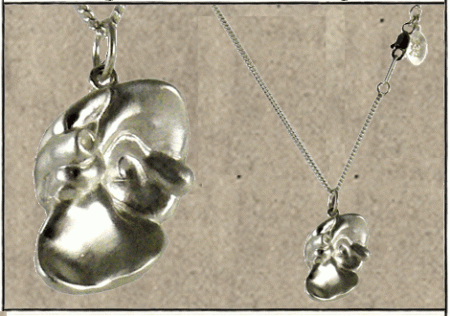
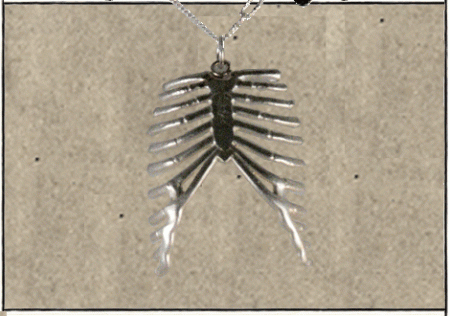
Melbourne jewelry designer and silversmith Julie Parker has a line of anatomically correct pendants, entitled Black Jewls. These pieces are beautifully detailed and well crafted.
Brain:

Heart:

Liver:
Ribcage:
Vertebrae (how cool is that!?):

Melbourne jewelry designer and silversmith Julie Parker has a line of anatomically correct pendants, entitled Black Jewls. These pieces are beautifully detailed and well crafted.
Brain:
Heart:
Liver:
Ribcage:
Vertebrae (how cool is that!?):
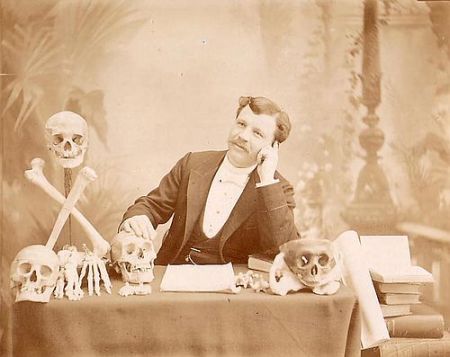
Every now and then I pop back on Luminous Lint to browse their fantastic photography exhibitions. Here are a few selections from the skull collection.
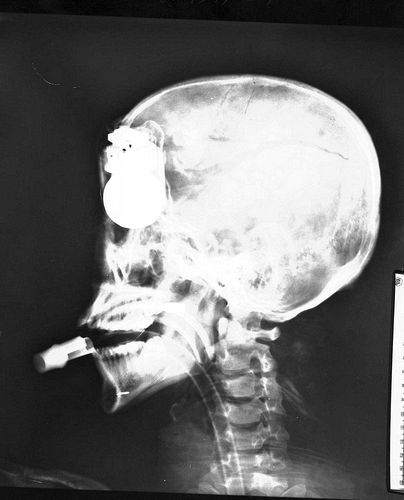
Some are actual medical images, quite disturbing (such as this 1966 Vietnam War X-ray of a grenade implanted in a man’s forehead):
Some are art photography…

(Look at the gentle detail of color in the eye of the feather!
More skulls here
I’ve posted about x-ray lamps, and now we have a design prototype for the x-ray umbrella.

I suppose I *could* assemble one of these myself, but for some reason the task seems daunting and difficult. Too bad it’s only a prototype and these umbrellas are not being manufactured. Since I’m a measly 5’2″, all the people towering above me would get an interesting eyeful if I pulled this out in the rain.
They say you never forget how to ride a bike. So if I ever hop back on one, this would be my helmet of choice (of course, I’d have to make my own version to save $200).
These Tibetan anatomical prints bring a kind of…for lack of a better word…FUN to medical illustration. Look at how happy these human diagrams appear to be!
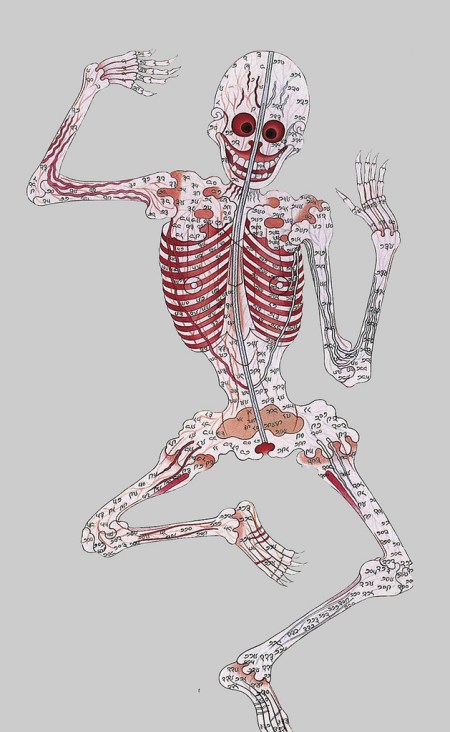
This reminds me of eggs and bacon for some reason. With a side of joy.
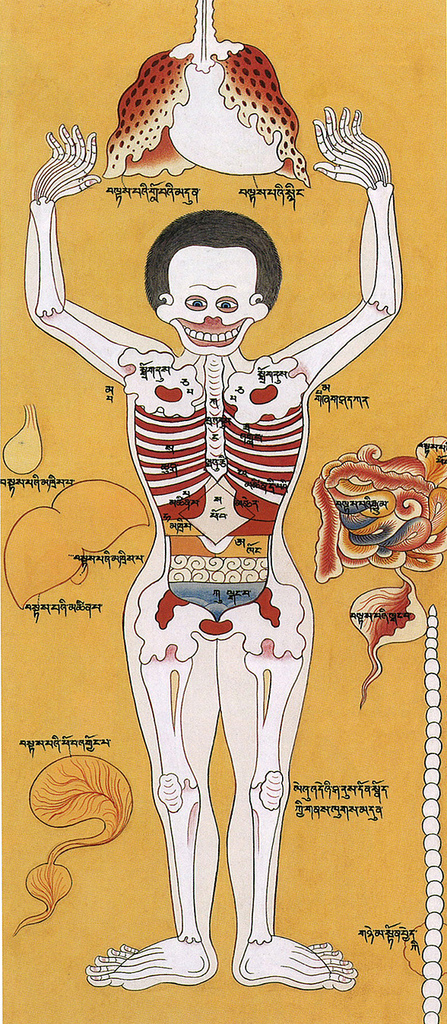
If these are anatomically correct, our culture is entirely populated with miserable bastards. That skull alone has more charisma than 90% of humans.
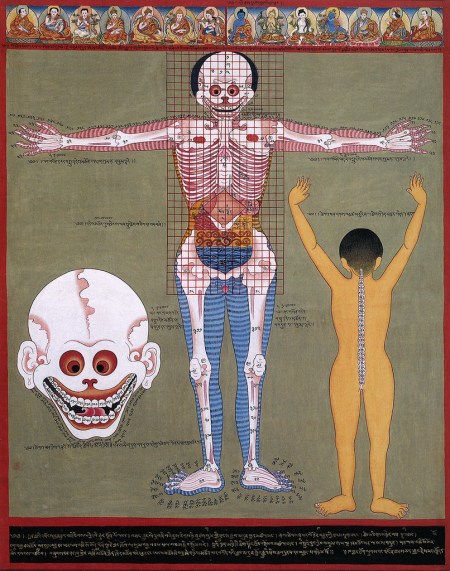
One word: DANCE.
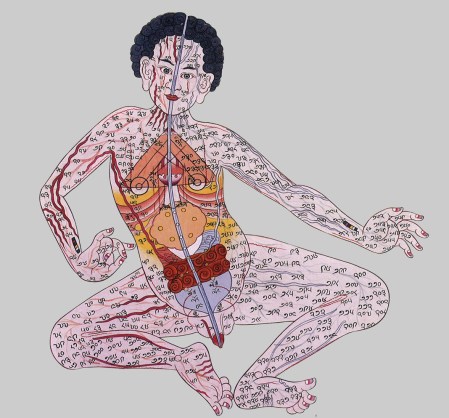
I’m in a good mood now.
More at Ephemera Assemblyman.
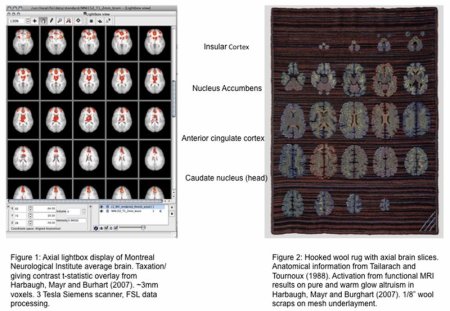
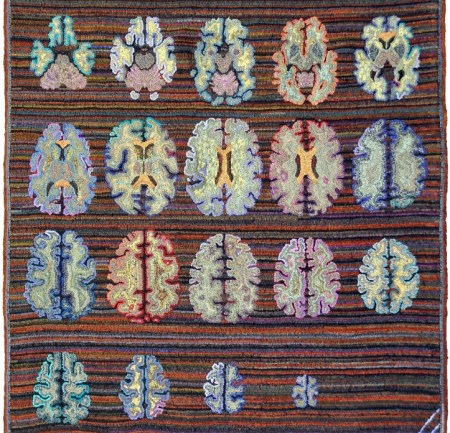
This is the kind of rug that I’d love to have in my home (or future office), but may not allow anyone to walk on. Rather like those decorative “guest towels” that no one in the household dares to touch.
Even better, the scan depicts brain function during a state of warm altruism. I’m in love. Oh fMRI rug, you had me at “axial brain slices.”
Bringing home the first ultrasound visions of a growing fetus is indeed and exciting moment for expectant parents. But thanks to Jorge Lopes’ PhD program at Royal College of Art, parents can now have a 3-D life sized model of the “bun in the oven” to take home.
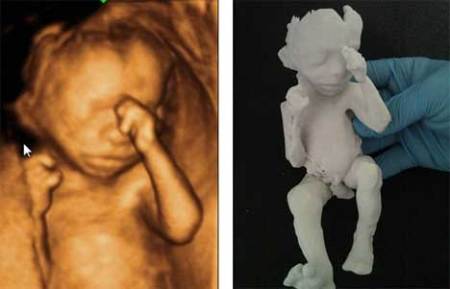
Dr. Lopes has pioneered a process to convert ultrasound and MRI data into plaster models.

The technology is a rapid prototyping machine; a 3-D printer that “builds” the model with plastic powder in much the same way a regular printer builds an image with ink.

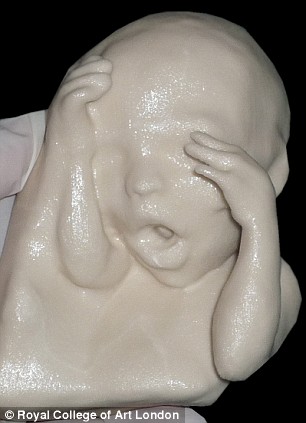
The replicas are an odd fusion of art and science, with far reaching implications (some of which include helping blind mothers to bond with babies prior to birth, or detecting developmental abnormalities).


Lopes researched the practical implications of model making in medicine over the centuries, and began his work with images of mummies, dinosaurs…then fetuses.
Some of the models can be rather haunting.
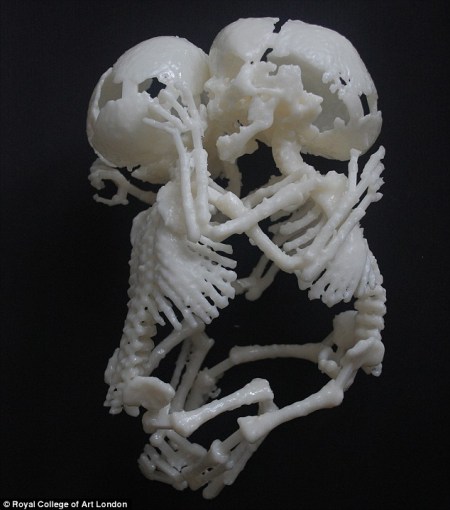
Despite the fact that the fetuses were undoubtedly quite comfortable in their cozy wombs when the images were captured, for some reason the sculptures appear frozen in a tortured moment of time. At least to me. Maybe it’s different when you’re looking at your own offspring.
I don’t necessarily recommend carrying these models around to show off, in lieu of classic ultrasound images. Though I personally wouldn’t be put off if a friend reached into her purse and pulled out a plastic embryo…I can’t speak for the rest of the population.
I find this creation by Laurent Massaloux to be rather enchanting.
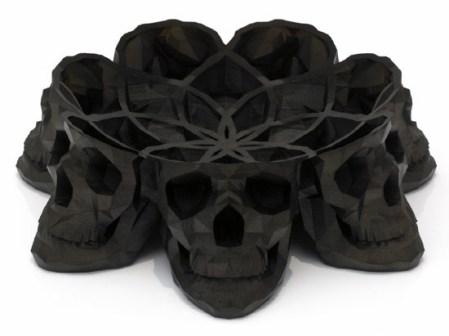
The ‘Vanity Tidy’ bowl [was designed] on the theme of the vanities of life: time, wealth and ownership. The form was captured from the web, digitally manipulated, and then transmitted to a rapid prototyping program where it was formed three dimensionally by laser fusion in polyamide powder. ‘Vanity Tidy’ is composed of seven human skull structures placed in a circular mode.

The lotus design that appears when viewing the piece from above is my absolute favorite part of the bowl. I have a particular appreciation for lotus flowers due to their rich symbolism. Fusing a lotus image with human skulls is a statement I could probably spend way too long happily and poetically pondering.

I came across this model on Phisick, a wonderful medical antique site.
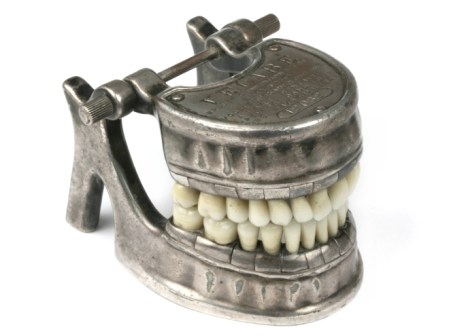
Isn’t it wonderful? Rather like H.R. Giger designed a dental device.
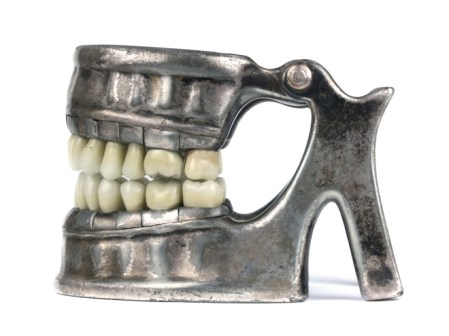
A well fashioned French antique dental model by Vecabé. The full set of teeth are made from enamel and would have been painstakingly crafted and fired individually. Each one is secured to the mandible with brass pin and can be removed. They fit together perfectly to form an anatomically correct bite. The heavy metal block opens through 180 degrees to allow detailed inspection.
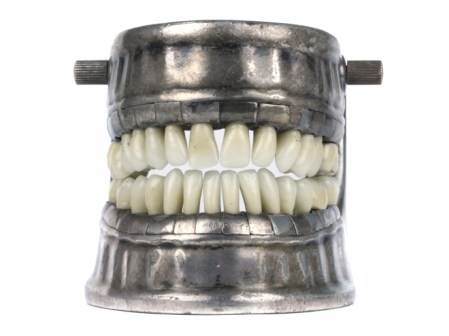
Source (with more photos)
I can’t find as much information as I’d like on Michel Henricot, so I’ll just marvel at a few of his paintings for a while.
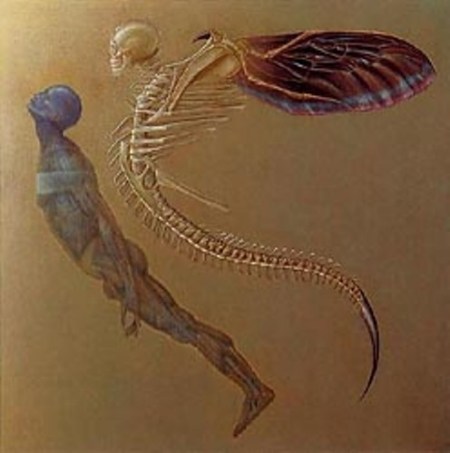
Henricot has a talent for musculature and anatomy, veiled by translucent skin and hazy lighting. This is not the stark work of textbooks. Nor is it merely the fantastical work of a gifted surrealist.
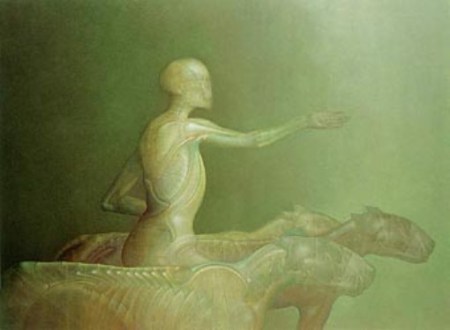
His work dances between the technical and the mystical until vastly divergent styles can no longer be separated. Henricot’s imagination is endowed with precision of form and function.

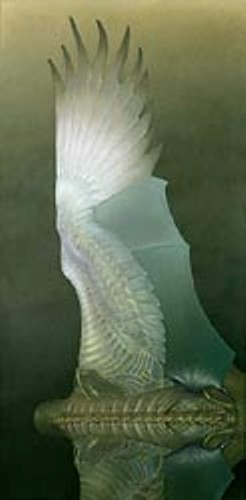
Here is a decent size gallery. So lovely…

 SheWalksSoftly