
Metal and the Hypothalamus gland…two of my favorite things! I’m overjoyed that someone made this (and grateful for the subtitles!):
The Hypothalamus is so underappreciated. I’m glad someone paid tribute.
Found here.
Metal and the Hypothalamus gland…two of my favorite things! I’m overjoyed that someone made this (and grateful for the subtitles!):
The Hypothalamus is so underappreciated. I’m glad someone paid tribute.
Found here.
I’m not one for outlandishly expensive jewelry, but I must admit that Romaine Jerome’s latest watch creation is pretty incredible.
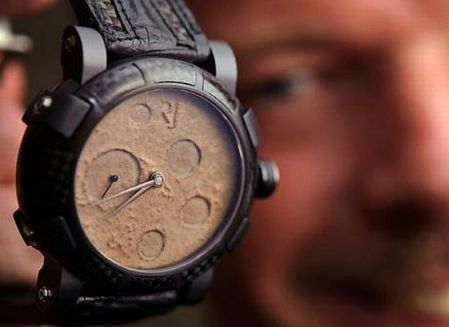
This piece is part of the Moon Dust-DNA collection, which includes watches made from moon dust (obviously), parts of the Apollo 11 rocket and bits of spacesuits.
It’s like wearing a mini museum on your wrist! Though the price range is $15,000-$500,000…so I’m afraid I’ll be sticking to the price of regular museum admissions.
I tend to do image searches for random things I’m reading about, many of which pertain to neuroscience. This vision of merging dendrites blew me away:

These electrical storms…these trees of fire…are operating, thousands upon thousands, in your brain right now. Who knew the merging branched projections of a neuron could be so breathtaking?
On a related note, look at this stunning Butterly Brain greeting card! Favorite colors…favorite things…
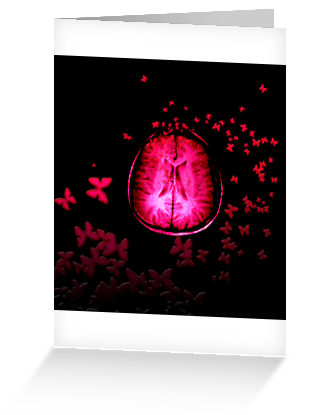
By graphic designer Tweek
I have a strange fascination with dead sciences; the so-called discoveries, championed by experts for years and subsequently discarded as nonsense. Of course, we are by no means past our tendency to espouse a theory wholeheartedly until something comes along to disprove it.
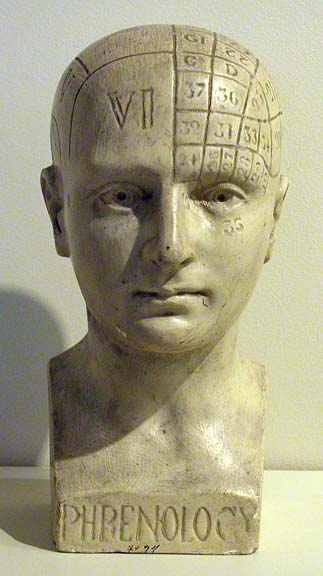
Phrenology was a rather popular (now defunct) science in the nineteenth century, purporting that mental faculties and personality traits corresponded with cranial bone formation.

I love the old charts and models (I’ve used some of these images in jewelry, clothing and other craft designs)…



Equipment included measuring devices and even electric “testing helmets:”

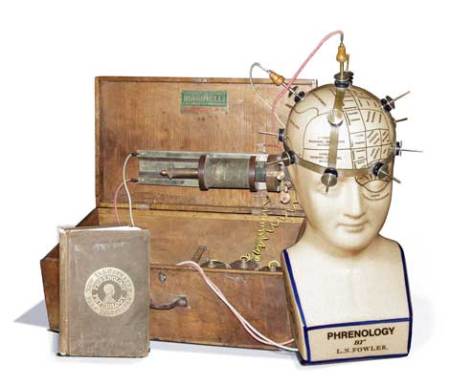
Should you want your own model, you can purchase a Dr. Willarton Phrenology Head

Or a L.N. Fowler Phrenology Head

People seem surprised that I don’t already own one of these. In time…in time…
And look at this fantastic set of miniature head models, made by William Bally in 1831:


Although disproved long before, 1931 saw the advent of the Robot Phrenologist:
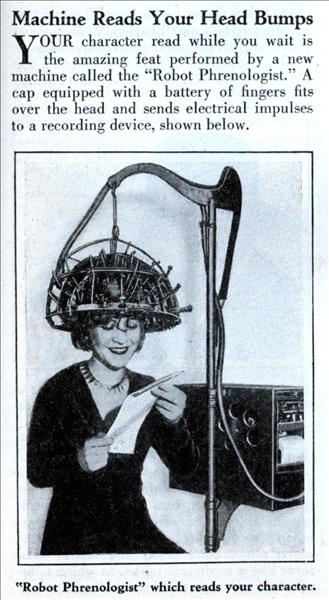
I must hand it to the phrenologists for being the first to roughly conceive cognitive localization.
Modern imaging technology presents a weighty issue when it comes to brain scans. Although certain connections can be made between activity, thought and specific brain regions, there are definitely limits of cognitive function localization.

There is a book
Some have postulated that there are more connections in the human brain than atoms in the known universe. Whether or not there’s any validity to this statement, it is clear that neuroscience can’t transform raw data into complex thought patterns. We’ve yet to uncover exactly where “identity” is located.

Image: Lost Identity
Even as an avid student of mind-body medicine and neuroscience, I like that human beings can’t be relegated to a series of bits and bumps.
Note: while posting this I kept thinking of the Simpsons.
Smithers: Sir, phrenology was dismissed as quackery 160 years ago.
Mr. Burns: You WOULD say that! You have the brain pan of a stage coach tilter!
I received links to this kit from a number of people, and it is indeed quite post-worthy.

From Oak Ridge Associated Universities: “This was the most elaborate Atomic Energy educational set ever produced, but it was only only available from 1951 to 1952. Its relatively high price for the time ($50.00) and its sophistication were the explanation Gilbert gave for the set’s short lifespan. Today, it is so highly prized by collectors that a complete set can go for more than 100 times the original price.
The set came with four types of uranium ore, a beta-alpha source (Pb-210), a pure beta source (Ru-106), a gamma source (Zn-65?), a spinthariscope, a cloud chamber with its own short-lived alpha source (Po-210), an electroscope, a geiger counter, a manual, a comic book and a government manual ‘Prospecting for Uranium.”
The Sound Advice Project is to designed to help parents talk to their children about drugs. They take a recorded statement and reproduce the exact form the of the sound waves in a bracelet design.

Personally, I think this would make a phenomenal gift for a good friend, or even better…a token of geek romance. What could be more romantic than wearing a rendition of the wavelength, frequency and amplitude of your sweetheart’s voice?
Pardon me while I stare into space and daydream about longitudinal waves…
After wanting to go for the longest time, I finally paid a visit to Evolution. This place is a truly incredible wunderkammer of natural history.

I wish I had taken my camera. I spent a good hour in the store, examining all of the unique treats: fossils, bones, stones, shells, insects, jewelry, medical models, ancient artifacts, taxidermy specimens.
I was surprised at how reasonable the prices were. For under $150, you can purchase a freeze dried two-headed bat, mounted and preserved in glass (regular bats are only $49!).
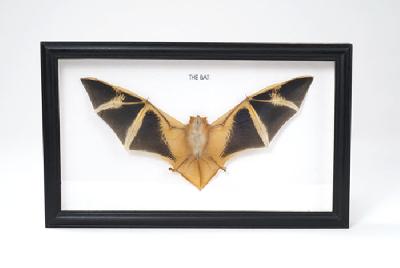
(I have a personal quirk which makes me unable to purchase even the most interesting taxidermy because I can’t stand the thought of a creature being intentionally snuffed out for the sake of display. In a museum? Perhaps. In my house…not a chance).
If man eating Piranha are more your speed, look for further.
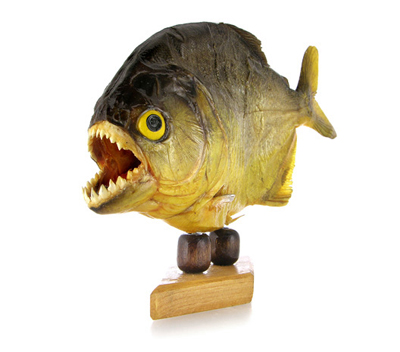
They even carried the entire collection of Kikkerland Anatomical Puzzles!
I was quite proud of the restraint I showed, leaving with only a tiny fossilized Trilobite.

It feels quite special to have this artifact that is over 300 million years old, like a strange connection to a nearly unfathomable history.
If you are in NY, I highly recommend paying evolution a visit.
ArcAttack has it all: Tesla coils, creepy circus music…well, those are the big selling points for me anyway.
ArcAttack employs a unique DJ set up of their own creation (an HVDJ set up) to generate an ‘electrifying’ audio visual performance. The HVDJ pumps music through a PA System while two specially designed DRSSTC’s (Dual-Resonant Solid State Tesla Coils) act as separate synchronized instruments.
These high tech machines produce an electrical arc similar to a continuous lightning bolt which put out a crisply distorted square wave sound reminiscent of the early days of synthesizers.
See more videos here.
The Radiology Art Project presents visualizations of culturally significant objects such as toys, food and electronics.
Here we have a CT scan of a toy elephant, complete with the “jiggle engine” that causes the animal’s body to vibrate when you pull the tail:

I can imagine this poor fellow is experiencing some bowel discomfort:

Colors in these images correspond with material densities in the object. The McDonald’s fish sandwich is a rich tapestry of varying densities and textures:
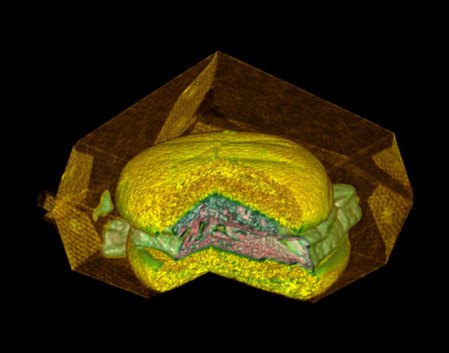
See more everyday objects in ways you’ve never seen them before here.
Each year, Nikon has a contest for the finest images in photomicrography. I was most drawn to forms of life in their first recognizable stages. The embryos and larvae are amazing.


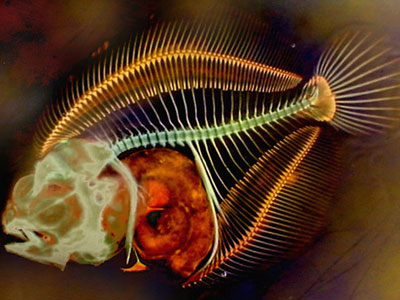
Browse the galleries and catch a glimpse of the beauty within the seemingly invisible spaces of our world.
 SheWalksSoftly