There is some stunning nanoscale photography peppered throughout various blogs and science publications. Here are a few favorites I’ve come across.
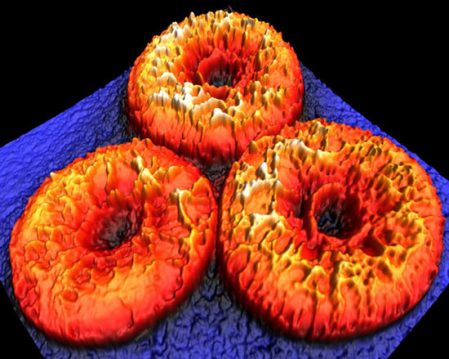
These red blood cells have been treated with an antibiotic called Phyllomelittin, which apparently has the benefit of making cells appear delicious:
Source (and a few more great photos)
This “tiny doll,” designed by researchers at the University of Tokyo’s Institute for Industrial Sciences, uses a new method of cultivating three dimensional biological structures.

The researchers created the tiny figurine by cultivating 100,000 cell capsules — 0.1-millimeter balls of collagen, each coated with dozens of skin cells — together inside a doll-shaped mold for one day. After the cell capsules had coalesced to form the doll-shaped mass of tissue, it was placed in a culture solution, where it reportedly survived for more than a day.
The technique may be useful to create bodily organs and tissues with complex cellular structures, aiding the fields of regenerative medicine and drug development.
Source
This gorgeous rose-like image from the Research Materials Society was subsequently turned into a guessing game.

The question:
This tiny rose (above) was made by mixing an exotic element with hydrazoic acid. That element was discovered in Germany, is a soft and silvery metal with a low melting point, and was used to lubricate the bearings of aircraft during World War II. What is it?
Source (and some answers posted)







 SheWalksSoftly