
This vintage ad is sure to spark at least mild confusion, at least for people of my generation. I admit to having no clue what the “air-breathing, flesh-soft” substance actually is.

Ideas?
This vintage ad is sure to spark at least mild confusion, at least for people of my generation. I admit to having no clue what the “air-breathing, flesh-soft” substance actually is.
Ideas?
The ever-entertaining John K posted this awesome vintage Mighty Mouse toy.

It has an off-kilter intensity that I find pretty delightful. I could never be certain if this thing were out to “save the day”…or murder me in my sleep without remorse.

Don’t you love his sparse, wind-swept eyelashes? And here’s my favorite part: the tag reading “AN IDEAL ULTRAFINE ANIMAL” (conspicuously dangling over his disturbingly defined mouse crotch).


I can always count on John K’s blog!
Note: for some reason I accidentally wrote down “Mickey Mouse” instead of “Mighty Mouse” despite the fact that I knew it was the latter…has Disney seeped that far into my subconscious??? Thanks to those who pointed this out!
Given the rising popularity of all things steampunk, I’m pretty sure Alessandro Maffioletti’s vintage imagery collages are going to go viral on the Web.

They really are quite lovely surreal constructions.


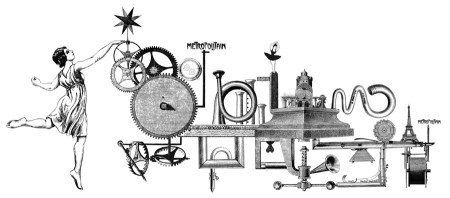
Get your fill of gears, instruments, creatures and technology of days gone by, spliced together in odd harmony here.
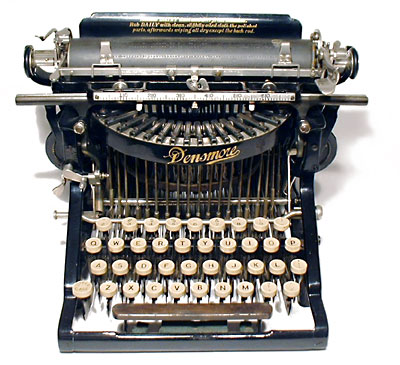
The Martin Howard Collection of antique typewriters is stunning. The first half of the 20th century ushered in a wave of mechanical ingenuity, and Howard’s collection showcases some of the greatest (and less-than-spectacular) efforts of manufacturers to keep pace with the demand for new writing machines.
Most of us are familiar with the standard shape and design of typewriters such as the Densmore.
But some inventors steered entirely clear of things like…keyboards, often at the expense of speed and efficiency.
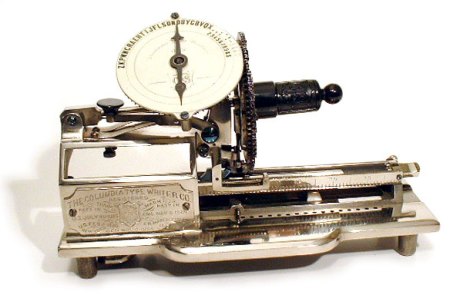
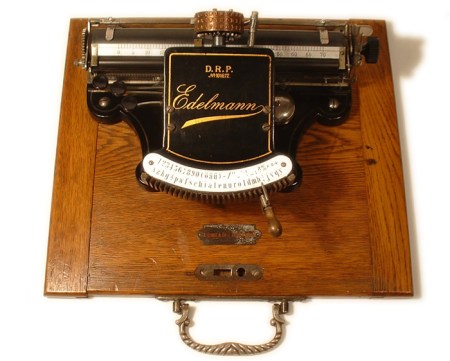
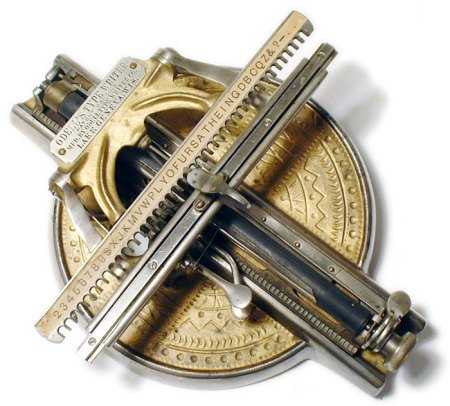
I was amused to see that even at the dawn of industrialization, the need to create innovative gadgets was so prevalent. This collection of beautiful (and bizarre) machines is a fantastic glimpse into our typographical history.
See the rest (along with descriptions) here.
In the 1920’a Fritz Kahn released a series of books depicting the human body using industrial metaphors: switchboards, assembly lines, conveyor belts, projectors, machinery, workers, etc.

His modernist style made use of the growing popular fervor over industrial development, and his exploration of the anatomical relationship to man-made structures is intriguing.
Here we have the nervous system visually compared to an electronic signaling system with the brain as an office where messages are sorted.


I feel very lucky to know a few people who will attend (or would be willing to attend, if distance permitted) the Iconography of the Industrial Body lecture tonight, which will cover some of Kahn’s work.

Body as Machines gallery.
Don’t get discouraged by the beginning of this video. If the cyclist doesn’t impress you, stick around for the burlesque dancer at 0:54. Sir Rollin D. Bones (starting at 1:50) is amazing. Best skeleton dance moves ever caught on film.
Monster Brains just featured a great collection of vintage sci-fi book cover art. I have a few favorites from the bunch.
This one definitely warrants a caption contest. What exactly is the facial expression on the giant fish creature as he drains the blood of the young boy? Is he awestruck? Terrified? Aroused?

This enormous, lush-lipped bat seems to have whole forests on its hind quarters, and possibly a castle:

And you have to commend the imagination of this psychedelic, robotic, architectural, ant infested, lupine, space-collage skull…thing:

I can’t decide whether the Chocolate Phonograph (a rare artifact made by the German chocolate company Stollwerk in 1903) was genius, or a mad bastardization of my favorite things.
This little treasure, with a mere 3 inch turntable, was designed to play chocolate records. The craftsmanship is rather beautiful:
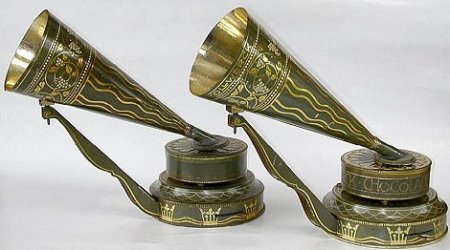
Though touted as a solid device that could rival other quality phonographs
In reality they were extremely delicate little machines with noisy, underpowered motors and mediocre sound quality. They were far too fragile to withstand rough handling by children, who were (not surprisingly) the main market for chocolate records. Most phonographs were likely broken beyond repair in a matter of days. The big advantage was the records themselves. As explained in La Nature, “when a song no longer pleases, oh well! just savor the disc like you would a simple snack, and eat it.”
I think I would have eaten all my music before I even got to play it. I prefer my music inedible, to avoid temptation.
Not much information exists for the general public about Jean Marembert. He is featured in the book Modern Figurative Painting: The Paris Connection

From the book description:
The first half of the 19th Century spawned one of the most exciting concentrations of artists and artistic innovation in history. The French impressionists opened the door to creative freedoms never before experienced, and a community rich in artistic and intellectual talent coalesced to forever change the direction of art.
Here are a few of Marembert’s illustrations for Petrus Borel’s Le Lycanthrope, which I especially love:


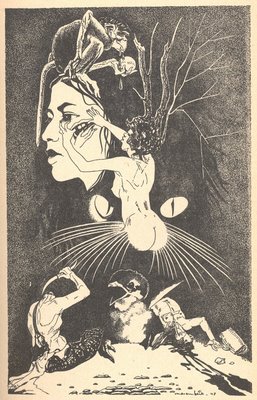
He seems slightly ahead of his time with these macabre collage illustrations.

Horror novels, comics, graphic novels and other forms of illustration in this style began to develop in the mid 20th century…though I don’t recall ever seeing anyone cite Marambert as an influence.


I have a strange fascination with dead sciences; the so-called discoveries, championed by experts for years and subsequently discarded as nonsense. Of course, we are by no means past our tendency to espouse a theory wholeheartedly until something comes along to disprove it.
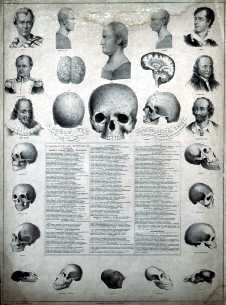
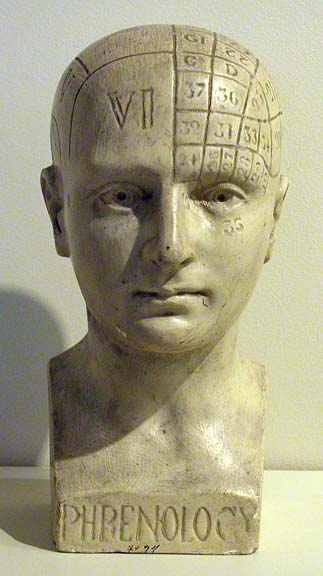
Phrenology was a rather popular (now defunct) science in the nineteenth century, purporting that mental faculties and personality traits corresponded with cranial bone formation.

I love the old charts and models (I’ve used some of these images in jewelry, clothing and other craft designs)…


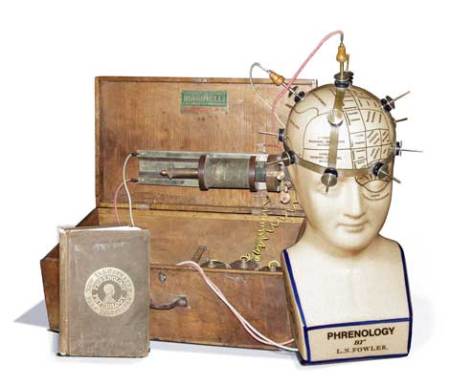
Equipment included measuring devices and even electric “testing helmets:”

Should you want your own model, you can purchase a Dr. Willarton Phrenology Head

Or a L.N. Fowler Phrenology Head

People seem surprised that I don’t already own one of these. In time…in time…
And look at this fantastic set of miniature head models, made by William Bally in 1831:


Although disproved long before, 1931 saw the advent of the Robot Phrenologist:
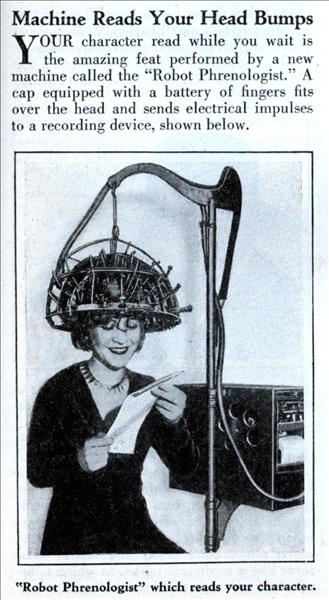
I must hand it to the phrenologists for being the first to roughly conceive cognitive localization.
Modern imaging technology presents a weighty issue when it comes to brain scans. Although certain connections can be made between activity, thought and specific brain regions, there are definitely limits of cognitive function localization.

There is a book
Some have postulated that there are more connections in the human brain than atoms in the known universe. Whether or not there’s any validity to this statement, it is clear that neuroscience can’t transform raw data into complex thought patterns. We’ve yet to uncover exactly where “identity” is located.

Image: Lost Identity
Even as an avid student of mind-body medicine and neuroscience, I like that human beings can’t be relegated to a series of bits and bumps.
Note: while posting this I kept thinking of the Simpsons.
Smithers: Sir, phrenology was dismissed as quackery 160 years ago.
Mr. Burns: You WOULD say that! You have the brain pan of a stage coach tilter!
 SheWalksSoftly