
What a great flickr set of “modern warning signs.”

Favorites for potential T-shirt design:


See the set here, from flickr user arenamontanus.
What a great flickr set of “modern warning signs.”
Favorites for potential T-shirt design:
See the set here, from flickr user arenamontanus.
Between the recent debut of Atlas Obscura and The Geek Atlas
Atlas Obscura is one of those sites I feel was designed specifically for people like me. I’ve already posted about a number of the attractions listed, and I look forward to the additions of fellow explorers.

Atlas Obscura is a collaborative project with the goal of cataloging all of the singular, eccentric, bizarre, fantastical, and strange out-of-the-way places that get left out of traditional travel guidebooks and are ignored by the average tourist. If you’re looking for miniature cities, glass flowers, books bound in human skin, gigantic flaming holes in the ground, phallological museums, bone churches, balancing pagodas, or homes built entirely out of paper, the Atlas Obscura is where you’ll find them.
I also stumbled upon The Geek Atlas

This book includes a general introduction to each destination’s significance, a related technical subject covered in more detail, and practical visiting information. Perfect!
In keeping with my love of geekwear (especially the subtle kind that can be incorporated into a normal wardrobe), I felt the need to post these Circuit Board Socks for men.
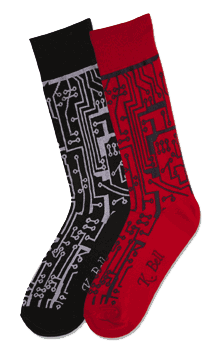
I suppose these would make a really great or really awful gift for an IT pro…depending on the guy.
The interwebs also seem to have a variety of circuit board cufflinks, if a gentleman is so inclined.
InformationWeek featured an interesting project in which artists Artists Alex Dragulescu and Julian Hodgson accepted a commission to create visualizations of computer viruses.
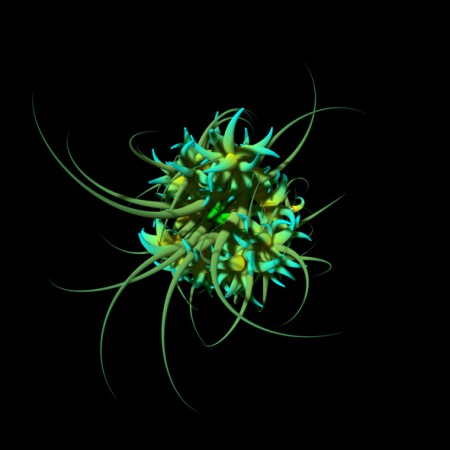
Using pieces of disassembled code, API calls, memory addresses, and subroutines associated with the bane of a security team’s existence, they analyzed the data by frequency, density, and groupings.
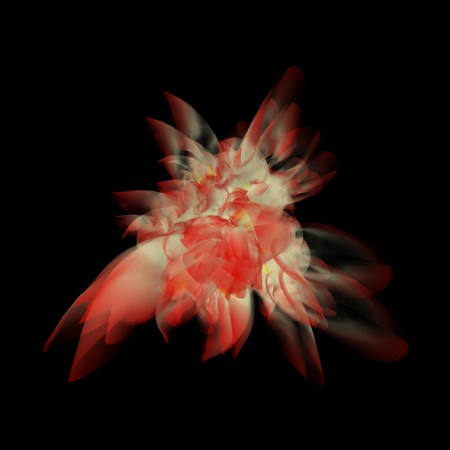
Algorithms were then developed and the artists mapped the data to the inputs of the algorithms, which then generated virtual 3-D entities.

The patterns and rhythms found in the data gave shape to the configuration of the artificial organisms, and the result was a series of images called Malwarez.

See the rest of the gallery, along with descriptions of each image here.
Those of us who grew up with classic gaming systems played them on TVs with phosphorescent tubing. CRT displays had their own unique texture, afterimage, color bleed and noise, all of which are lost in modern emulations of classic favorites.
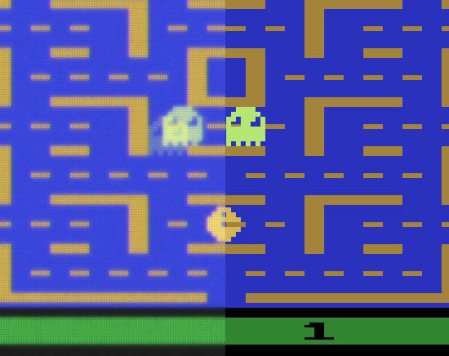
Admit it, fellow children of the 80’s: there is something soul-less and wrong about high definition Atari, with its crystal clarity and precise lines.
Thus Dr. Ian Bogost, an Associate Professor at Georgia Tech, asked a group of CS seniors to simulate a number of CRT behaviors using an Atari VCS emulator. The results were splendidly realistic.

“[The students] are currently working with the maintainer of the free, open-source Stella emulator to patch their changes into the main build, where the effects will be available as a configurable option. Expect to see it there shortly, where hopefully it will benefit players, creators, educators, and archivists alike.” –Source
Bare is a non-toxic body paint that allows you to become a human electrical conductor (sans electrocution) by applying it directly to the skin.

This innovative material allows users to interact with electronics through gesture, movement, and touch. Bare can be applied with a brush, stamp or spray and is non-toxic and temporary. Application areas include dance, music, computer interfaces, communication and medical devices. Bare is an intuitive and non-invasive technology which will allow users to bridge the gap between electronics and the body.
Wow. This is serious geek hotness.
It’s rare that I’m in front of a camera, but I would love to get my hands on this paint and collaborate with some tech savvy friends on a photo project! Who’s with me?
Thanks to Artie for sending this link.
Wow…this clip stirs technological and musical nostalgia in a way that makes my little heart flutter. There’s a real sweetness to these outmoded babies chugging along in harmony. I want so much to believe that my gigantic pile of obsolete electronics do this after I’m asleep at night.
There are no effects or sampling. Simply:
*Atari 800XL as the lead piano/organ sound
*Texas Instruments TI-99/4a as lead guitar
*8 Inch Floppy Disk as Bass
*3.5 inch Harddrive as the gong
*HP ScanJet 3C for all vocals.
Found here.
The Sound Advice Project is to designed to help parents talk to their children about drugs. They take a recorded statement and reproduce the exact form the of the sound waves in a bracelet design.

Personally, I think this would make a phenomenal gift for a good friend, or even better…a token of geek romance. What could be more romantic than wearing a rendition of the wavelength, frequency and amplitude of your sweetheart’s voice?
Pardon me while I stare into space and daydream about longitudinal waves…
I can pretty much guarantee that if I get married, my wedding will be slightly eccentric (in a classy and meaningful way, of course).
One thing I’ve always wanted to do is design and/or make my own dress. But here’s one thing I never envisioned…a light up dress!
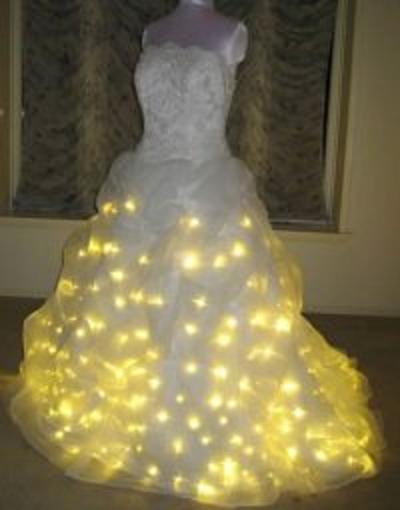
Although I wouldn’t want to glow this brightly on my trip down the aisle, I’m now wondering if a much more subtle LED network could be included in the pattern of the dress. Something that resembles faint, twinkling stars in a night sky.
 SheWalksSoftly